TRACK CHANGES is a platform for advanced longitudinal data analysis. Each module is a specialized statistical engine built to answer a different class of question about how people change over time — from the coupling dynamics between two constructs, to the architecture of full psychological systems, to the moment-by-moment signals buried in intensive data, to the pathways people travel between discrete states. Click a module below to learn more.

Bivariate Dual Latent Change Score modeling — two constructs, full coupling architecture
Models the reciprocal dynamic relationship between two constructs across time. Estimates whether changing on one construct drives changing on the other, whether symptom severity acts as a brake on recovery in the paired domain, and whether therapeutic momentum transfers across constructs.
Each one answers a different question about the same data — and the questions compound.
Use MOMENTS to find the session where the system destabilized before your patient improved. Use BRIDGES to identify what drove that improvement — and in which direction.
Use CHORDS to estimate the continuous coupling architecture of your construct network. Use STREAMS to characterize the discrete pathway types — Chronic, Sudden Gainer, Fragile Improver — that the continuous model averages over.
Use STREAMS to identify which participants were on a recovery trajectory and which were chronic. Use BRIDGES within each group to see if the coupling dynamics differ.
Use MOMENTS to detect when a critical transition occurred in intensive data. Use STREAMS to classify whether that transition reflected a stable state change or a temporary fluctuation.
The methods are different. The platform is the same. The output speaks the same language. That’s the point.
Every TRACK CHANGES module shares the same architecture — because rigor shouldn’t depend on which question you’re asking. Upload your data once. Receive a complete, publication-ready report every time. The same infrastructure applies whether you’re modeling coupling dynamics between two constructs or tracking state transitions across a full longitudinal panel.
TRACK CHANGES was independently validated against expert hand-coded Mplus syntax. Identical parameter estimates, fit statistics, nested model tests, and model selection outcomes across both the univariate and bivariate testing ladders.
The two-level interpretive framework implemented in BRIDGES is described in Hale (forthcoming), building on the B-DLCS foundations established by McArdle & Hamagami (2001) and the four-parameter specification in Grimm (2012).
TRACK CHANGES runs in any modern browser. The back-end relies exclusively on open-source R packages. Full lavaan and Mplus syntax exported for every model — complete transparency, no black-boxing.
Stop asking questions you can't answer. TRACK CHANGES gives you the model, the interpretation, and the output — free, in your browser, in under a minute.

TRACK CHANGES is a platform for advanced longitudinal modeling. BRIDGES, its first module, makes bivariate dual latent change score modeling accessible to any researcher with longitudinal data — and it's completely free.
BRIDGES generates every report from scratch based on the specific variables and their valence — whether each construct is something you want to go up or down. Two researchers running the same model on different constructs get completely different reports. Construct valence determines whether a positive parameter estimate means improvement or deterioration, whether a coupling effect is beneficial or harmful, and how every sentence of interpretation is worded.
Click any card below to see what BRIDGES produces for each feature.
Upload your data. Specify your constructs and valence. BRIDGES handles everything else — and exports the full model code so you can verify every decision.
B-DLCS models answer questions no other longitudinal method can — but six specific barriers have prevented widespread adoption. BRIDGES eliminates each one while preserving analytical rigor and researcher judgment.
TRACK CHANGES was independently validated against expert hand-coded Mplus syntax. Identical parameter estimates, fit statistics, nested model tests, and model selection outcomes across both the univariate and bivariate testing ladders.
TRACK CHANGES runs in any modern browser. The back-end relies exclusively on open-source R packages. Full lavaan and Mplus syntax exported for every model — complete transparency, no black-boxing.
Foundational methods papers and applied examples using the Grimm change-on-change specification and the classic bivariate LCS formulation — across a range of fields and write-up styles. Each paper is linked directly — see how researchers across fields frame research questions, derive and test hypotheses, and present results. No need to re-invent the wheel.
The papers that define the model, establish its mathematical foundations, and introduce the change-on-change extension that TRACK CHANGES | BRIDGES implements.
McArdle, J. J., & Hamagami, F. (2001). Latent difference score structural models for linear dynamic analyses with incomplete longitudinal data. In L. M. Collins & A. G. Sayer (Eds.), New Methods for the Analysis of Change (pp. 139–175). American Psychological Association.
Hamagami, F., & McArdle, J. J. (2001). Advanced studies of individual differences linear dynamic models for longitudinal data analysis. In G. Marcoulides & R. Schumacker (Eds.), New Developments and Techniques in Structural Equation Modeling (pp. 223–266). Psychology Press. doi:10.4324/9781410601858-13
McArdle, J. J. (2009). Latent variable modeling of differences and changes with longitudinal data. Annual Review of Psychology, 60, 577–605. doi:10.1146/annurev.psych.60.110707.163612
Grimm, K. J., An, Y., McArdle, J. J., Zonderman, A. B., & Resnick, S. M. (2012). Recent changes leading to subsequent changes: Extensions of multivariate latent difference score models. Structural Equation Modeling, 19(2), 268–292. doi:10.1080/10705511.2012.659627
Hale, W. J., et al. (under review). TRACK CHANGES: A platform for modeling and interpreting bivariate symptom dynamics in clinical research. Clinical Psychological Science.
This paper is the primary citation for TRACK CHANGES. See FAQ & Citation for the full reference.
These papers implement the full Grimm (2012) extension — the same specification used by TRACK CHANGES | BRIDGES — in which prior changes in one construct predict subsequent changes in another, in addition to prior level effects. A diverse range of write-up styles across clinical psychology, developmental science, cognitive neuroscience, and social psychology.
Dillon, K., Hale, W., LoSavio, S., Wachen, J., Pruiksma, K., Yarvis, J., Mintz, J., Litz, B., Resick, P., for the STRONG STAR Consortium (2020). Weekly changes in blame and PTSD among active duty military personnel receiving Cognitive Processing Therapy. Behavior Therapy, 51(3), 386–400. doi:10.1016/j.beth.2019.06.008
Crabtree, M., Hale, W., Meyer, E., Kimbrel, N., DeBeer, B., Gulliver, S., & Morissette, S. (2021). Recent changes in psychological inflexibility precede subsequent changes in posttraumatic stress. Journal of Clinical Psychology, 77(11), 2507–2528. doi:10.1002/jclp.23244
Wiedemann, M., Janecka, M., Wild, J., Warnock-Parkes, E., Stott, R., Grey, N., Clark, D. M., & Ehlers, A. (2023). Changes in cognitive processes and coping strategies precede changes in symptoms during cognitive therapy for posttraumatic stress disorder. Behaviour Research and Therapy, 169, 104407. doi:10.1016/j.brat.2023.104407
Hounkpatin, H. O., Boyce, C. J., Dunn, G., & Wood, A. M. (2018). Modeling bivariate change in individual differences: Prospective associations between personality and life satisfaction. Journal of Personality and Social Psychology, 115, e12–e29. doi:10.1037/pspp0000161
Kievit, R. A., Lindenberger, U., Goodyer, I. M., Jones, P. B., Fonagy, P., Bullmore, E. T., & Dolan, R. J. (2017). Mutualistic coupling between vocabulary and reasoning supports cognitive development during late adolescence and early adulthood. Psychological Science, 28(10), 1419–1431. doi:10.1177/0956797617710785
Rappaport, B. I., Jackson, J. J., Whalen, D. J., Pagliaccio, D., Luby, J. L., & Barch, D. M. (2021). Bivariate latent-change-score analysis of peer relations from early childhood to adolescence: Leading or lagging indicators of psychopathology. Clinical Psychological Science, 9(3), 350–372. doi:10.1177/2167702620965936
Griffiths, S., Kievit, R. A., & Norbury, C. (2022). Mutualistic coupling of vocabulary and non-verbal reasoning in children with and without language disorder. Developmental Science, 25(3), e13208. doi:10.1111/desc.13208
Klinger, H. M., et al. (2024). Latent change-on-change between amyloid accumulation and cognitive decline. Alzheimer's & Dementia. doi:10.1002/alz.14326
These papers use the standard classic McArdle et al. bivariate dual change latent score formulation — prior levels of one construct predicting subsequent changes in another — across trauma research, educational psychology, developmental neuroscience, and organizational behavior.
King, L. A., King, D. W., McArdle, J. J., Saxe, G. N., Doron-LaMarca, S., & Orazem, R. J. (2006). Latent difference score approach to longitudinal trauma research. Journal of Traumatic Stress, 19, 771–785. doi:10.1002/jts.20178
Ferrer, E., McArdle, J. J., Shaywitz, B. A., Holahan, J. M., Marchione, K., & Shaywitz, S. E. (2007). Longitudinal models of developmental dynamics between reading and cognition from childhood to adolescence. Developmental Psychology, 43, 1460–1473. doi:10.1037/0012-1649.43.6.1460
Ferrer, E., Shaywitz, B. A., Holahan, J. M., Marchione, K., & Shaywitz, S. E. (2010). Uncoupling of reading and IQ over time: Empirical evidence for a definition of dyslexia. Psychological Science, 21(1), 93–101. doi:10.1177/0956797609354084
Sbarra, D. A., & Ferrer, E. (2006). The structure and process of emotional experience following nonmarital relationship dissolution: Dynamic factor analyses of love, anger, and grief. Emotion, 6(2), 224–238. doi:10.1037/1528-3542.6.2.224
Gawke, J. C., Gorgievski, M. J., & Bakker, A. B. (2017). Employee intrapreneurship and work engagement: A latent change score approach. Journal of Vocational Behavior, 100, 88–100. doi:10.1016/j.jvb.2017.03.002
Kievit, R. A., Brandmaier, A. M., Ziegler, G., van Harmelen, A.-L., de Mooij, S. M. M., Moutoussis, M., … Dolan, R. J. (2018). Developmental cognitive neuroscience using latent change score models: A tutorial and applications. Developmental Cognitive Neuroscience, 33, 99–117. doi:10.1016/j.dcn.2017.11.007
Gao-Urhahn, X., Biemann, T., & Jaros, S. J. (2016). How affective commitment to the organization changes over time: A longitudinal analysis of the reciprocal relationships between affective organizational commitment and income. Journal of Organizational Behavior, 37, 515–536. doi:10.1002/job.2045
We feature published and in-press papers that used TRACK CHANGES or the Grimm change-on-change specification in their analyses. This list grows as the community grows — if your paper belongs here, let us know.
Submit Your Paper →We build end-to-end statistical software pipelines so clinical researchers and methodologists can focus on the science — not the code.
Longitudinal data contains answers that most researchers never get to ask. The questions are there: does this drive that? Who actually changed? When did the system shift? Which path did they take? — but the methods to answer them have required expensive software licenses, advanced SEM training, and deep familiarity with model specification that most applied researchers don't have and shouldn't need. That gap between what the science can do and what researchers can actually access doesn't just create inconvenience — it determines which questions get asked, which findings get published, and ultimately which patients benefit, which interventions get adopted, and which problems stay unsolved.
TRACK CHANGES is our answer. A platform of specialized modeling tools, each built to make a different class of advanced longitudinal analysis accessible to any researcher with data and a question. Built entirely on open-source R infrastructure, free to use, runs in any browser. We've funded its development ourselves — a labor of love rooted in the conviction that democratizing sophisticated quantitative methods accelerates science. Every module, every feature, every automated interpretation is built with one question in mind: what does the researcher actually need?
Get in touch about supporting the work →You have the question and the longitudinal data. Whether it is symptom dynamics in a clinical trial, skill development in an educational study, performance metrics in an organizational dataset, or behavioral outcomes in a public health cohort — if you are asking how things change over time and what drives that change, TRACK CHANGES was built for you.
Upload your data, configure your constructs, and get back a complete answer: which variables drive change in the others, how the system is organized, when the dynamics shifted, and which discrete pathways your participants followed — with publication-ready output and a fully interactive report. No code required.
You know the models. You may have taught them. And you know what running one from scratch actually involves: hours of syntax, a nested model ladder tracked manually, assumption testing with no standardized workflow, custom visualization code, and an interpretation step where sign, significance, and valence interact in ways that are genuinely easy to misread.
TRACK CHANGES automates every stage — model selection, syntax generation, estimation, diagnostics, visualization, interpretation — while exporting complete lavaan and Mplus code so you can inspect and teach from every decision it makes.
Leads scientific vision and product strategy at Inflection Analytics. Primary interface with the academic and clinical research communities — ensuring TRACK CHANGES reflects the methods researchers actually need and the questions they're actually asking. Directs development of the underlying B-DLCS methodology and translates cutting-edge longitudinal modeling into accessible software pipelines.
Willie J. Hale, Ph.D. is a quantitative methodologist and mental health intervention researcher whose work asks one deceptively simple question: Who gets better — and why? He answers it by applying advanced statistical models to clinical trial data, with expertise spanning longitudinal structural equation modeling, dynamic systems modeling, dyadic data analysis, multilevel modeling, conditional process modeling, and psychometric methods.
Dr. Hale holds a Ph.D. in Psychology from the University of Texas at San Antonio (2015) and completed a Post-Doctoral Fellowship in Trauma Psychology at UT Health San Antonio. He is the founder and Director of the Investigating Models of Psychological Adjustment, Coherence, and Trauma (IMPACT) Laboratory at UTSA and serves as Biostatistician for the STRONG STAR Research Consortium and the Consortium to Alleviate PTSD — the largest federally-funded military PTSD research network in the country.
His publication record spans 65+ peer-reviewed articles across high-impact journals in clinical psychology, traumatology, and behavioral medicine. As PI, Co-PI, Co-I, and statistical consultant, he has contributed to more than $66 million in funded research from the Department of Defense, the National Institutes of Health, the Department of Veterans Affairs, and private organizations. His work has been recognized with the UTSA President's Distinguished Achievement Award in Research, the Military Health System Research Symposium Outstanding Research Accomplishment Award, and a competitive NIH Loan Repayment Program Award.
Directs organizational operations, project management, and strategic partnerships at Inflection Analytics. Krysta ensures the infrastructure, processes, and people behind TRACK CHANGES operate with the same precision the mission demands.
Krysta Hale is a retired U.S. Air Force C-130 pilot whose career spanned operational flying, force-wide personnel systems management, and high-stakes joint command liaison work. As an assignment officer, she managed the entire C-130 pilot portfolio — balancing personnel inventory against global mission requirements, designing the career development pipelines that determined where pilots flew, when, and at what stage of their progression. The role demands exactly the kind of systems-level thinking that is rare in operations: understanding how individual decisions ripple across a complex, interdependent structure at scale.
She also served as the AFCENT Liaison to CENTCOM — the interface between U.S. Air Forces Central Command and the joint combatant command responsible for U.S. operations across 20 nations from the Horn of Africa through Central Asia. That role required translating between organizational cultures operating under different doctrines and priorities, synthesizing intelligence and operational data for senior decision-makers, and ensuring air component equities were represented in joint planning at the strategic level.
She brings that same discipline to Inflection Analytics — managing the organizational systems, partner relationships, and operational infrastructure that allow the science and software to move forward with the precision the mission demands.
Leads all software architecture, development, and technical infrastructure at Inflection Analytics. Mario is the engineering force behind TRACK CHANGES — translating complex methodological requirements that most developers would find impenetrable into a production system that runs reliably in any browser, generates complex statistical output in under a minute, and produces interactive reports that are ready to publish.
Mario Anderson is a software architect and full-stack developer with 15+ years of experience building production-grade systems across multiple industries. He has led development projects from initial architecture through deployment at multiple companies, working across the full technology stack — from database design and back-end API development to front-end interfaces built for real users under real conditions.
His technical range spans the languages and frameworks that modern software actually demands: Python, R, JavaScript, SQL, and beyond — with deep experience in relational and non-relational database architecture, cloud infrastructure, and the data pipeline work that sits at the intersection of statistics and software engineering. He has a particular focus on building interfaces that don't just work, but that make complex systems feel simple — the design philosophy that makes TRACK CHANGES accessible to researchers who have never written a line of code.
At Inflection Analytics, Mario is responsible for all technical architecture, platform development, and infrastructure decisions. He built TRACK CHANGES from the ground up, and continues to drive the platform's expansion toward multiple-group models, covariate support, and a unified longitudinal modeling framework.
Leads platform experience and youth outreach development at Inflection Analytics. Reagan is the internal voice of the user — the person who catches what doesn't work before anyone else does, and asks why it was built that way in the first place. She drives the technical and pedagogical side of the organization's youth initiatives, shaping both what gets built and how it gets taught.
Reagan leads the development side of Inflection Analytics' STEM outreach programming — identifying what students actually want to learn, designing the curriculum architecture for the statistics and coding bootcamps, and building the frameworks that guide summer internship programming. She approaches education the way the organization approaches software: start with the question, work backward to the method.
On the platform side, Reagan contributes to the design of the plain-English interpretation algorithms that sit at the core of TRACK CHANGES — the logic that turns parameter estimates into readable, valence-aware narratives. She provides iterative UI feedback across development cycles and handles front-line debugging as new features and platform iterations roll out, testing edge cases and surfacing issues before they reach users.
Leads creative strategy and community engagement at Inflection Analytics. Avery shapes how the organization looks, sounds, and shows up — from the visual identity of the platform to the way it reaches students, researchers, and the broader public. She is responsible for making sophisticated statistical software feel accessible and worth caring about.
Avery leads graphic design across the platform and website — developing the visual language that translates complex methodology into clean, readable interfaces and materials. She manages Inflection Analytics' social media presence, building the community of researchers, educators, and students who follow the platform's development and mission.
On the outreach side, Avery coordinates the logistics and partnerships behind the organization's STEM programming — managing relationships, scheduling, and the community infrastructure that makes the bootcamps, internships, and youth initiatives actually run. She also contributes to the plain-English interpretation algorithm work, focusing on how algorithmic output reads to audiences without a quantitative background.
TRACK CHANGES is built on deep methodological expertise in longitudinal modeling, federal grant biostatistics, and clinical research design. For projects that need that expertise applied directly — we consult. We approach every engagement as a partnership, not a transaction, and we are always looking for new opportunities to support rigorous science.
Consulting, study design, and biostatistical support contributing to over $66 million in federal funding from the DoD, VA, NIH, NSF, and private organizations — with a lifetime funding rate approaching 30%. The right methodological partnership moves science forward.
Custom analysis and modeling from data cleaning through publication-ready output — and we do not stop at the statistics. We write it up too. Full results sections, interpretation, tables, and figures, so you can focus on the science. Especially powerful for TRACK CHANGES-based analyses, where we handle the entire workflow end-to-end.
Expertise in SEM, longitudinal methods, mixed models, dyadic data analysis, network analysis, dynamic systems modeling, conditional process modeling, and categorical data analysis.
Also available: custom analyses for methodological extensions not yet implemented in TRACK CHANGES — including multiple-group B-DLCS models, latent trajectory analysis, latent transition analysis, longitudinal conditional process models, and fluid vulnerability models.
Power analysis, sample size justification, analytic plans, and biostatistics sections for NIH, DoD, PCORI, VA, NSF, and private foundation proposals. Contributing to a lifetime funding rate approaching 30% across submitted applications.
Grant deadlines are firm. Proposal biostatistics support typically requires 2–4 weeks minimum. Reach out early — we will give you an honest timeline and make it work.
We approach consulting as a partnership — whether you need a biostatistician for a single grant section or a long-term collaborator across multiple studies. Hourly, project-based, and retainer arrangements available.
Tell us about your project, timeline, and goals. No commitment required. We will tell you honestly whether and how we can help.
We outline scope, deliverables, and timeline. Pricing is flexible — hourly, project-based, and retainer arrangements available depending on your needs.
We get to work. You stay in the loop at every stage. Deliverables are publication-ready — not just output dumps that leave you to figure out the rest.
We work with individual investigators, research teams, and institutions at all career stages.
TRACK CHANGES is a platform. One upload interface. One report format. One standard for what rigorous longitudinal analysis looks like. Each module is a specialized statistical engine built to answer a different class of question about how people change over time — from the coupling dynamics between two constructs, to the architecture of full psychological systems, to the moment-by-moment signals buried in intensive data, to the pathways people travel between discrete states.
Every module shares the same philosophy: you upload your data, configure your constructs, and receive a complete, publication-ready report — no code, no statistical software, no expertise required beyond knowing your research question. Same data format. Same report language. Same standard of rigor. Every time.
The tools below represent what we are building. BRIDGES is available now. The rest are coming.
Bivariate Relations Identifying Drivers of Growth in Embedded Systems
Coordinated Higher-Order Relational Dependency Synthesis
Momentary Observations; Modeling Experience Networks, Transitions & Signals
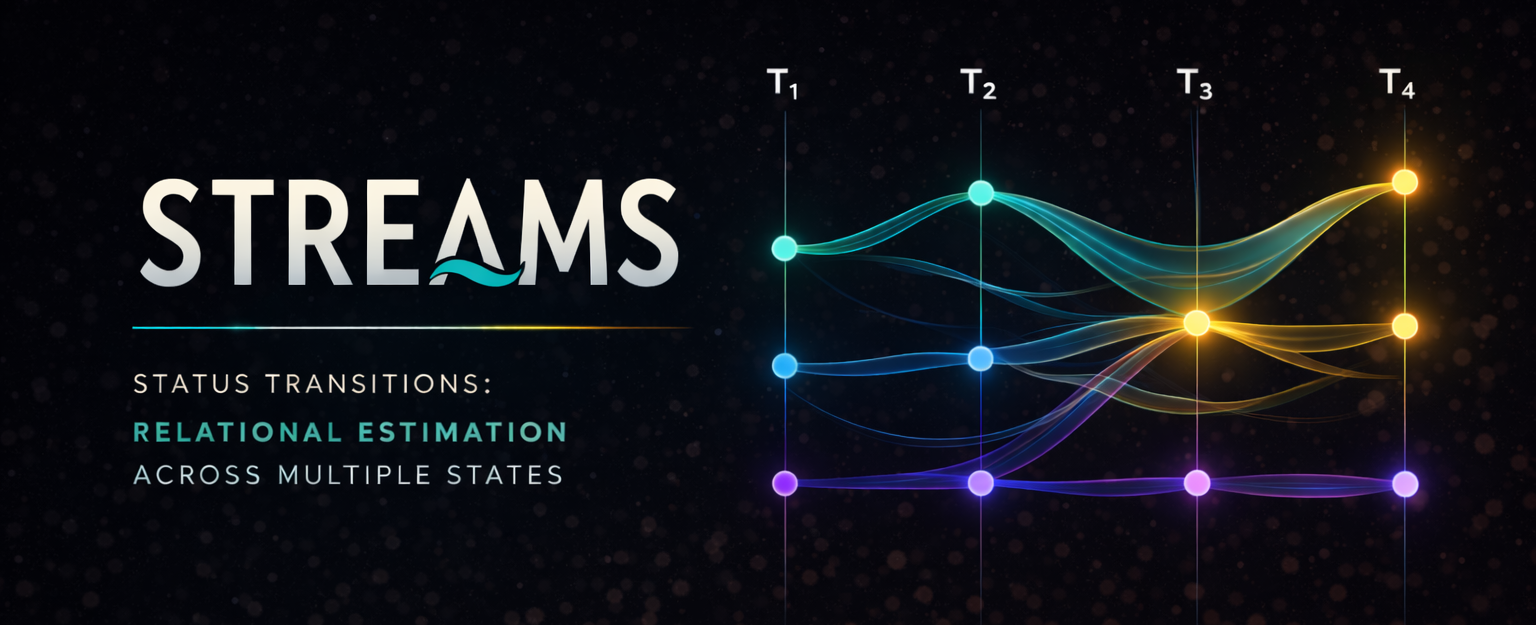
Status Transitions: Relational Estimation Across Multiple States
Each one answers a different question about the same data — and the questions compound.
Use MOMENTS to find the session where the system destabilized before your patient improved. Use BRIDGES to identify what drove that improvement — and in which direction.
Use BRIDGES to model the relationship between two key constructs. Use CHORDS when you have five and need to know which one is the hub the whole system revolves around.
Use STREAMS to identify which participants were on a recovery trajectory and which were chronic. Use BRIDGES within each group to see if the coupling dynamics differ.
Use MOMENTS to detect when a critical transition occurred in intensive data. Use STREAMS to classify whether that transition reflected a stable state change or a temporary fluctuation.
The methods are different. The platform is the same. The output speaks the same language. That’s the point.
CHORDS, MOMENTS, and STREAMS are in development. No timeline — but when they launch, they will be free, fully documented, and integrated into the TRACK CHANGES platform you already know.
If you want to be notified when a new module launches — or if you have longitudinal data you think one of these tools was built for — reach out directly.
Get in Touch →pcls0, pcls1, pcls2... A sample dataset is available within the app.If you use TRACK CHANGES in your research, please cite the methods paper:
This paper is currently under review at Clinical Psychological Science. The citation will be updated with DOI upon acceptance.
Whether you need consulting, have a software question, or want to discuss a collaboration — reach out and we'll respond within one business day.
Select a category to learn more and get the right email address.
Have a question that doesn't fit neatly into another category? Whether you're curious about the platform, exploring a potential collaboration, or just want to introduce yourself — we'd love to hear from you. We respond to all inquiries within one business day.
support@inflectionanalytics.org →
BRIDGES makes bivariate dual latent change score modeling accessible to any researcher with longitudinal data. Upload your data. Specify your constructs. Receive a complete, publication-ready report that classifies the coupling architecture of your system and specifies the clinical subtype of every active path. No code. No statistical software. No expertise required beyond knowing your research question.
BRIDGES generates every report from scratch based on the specific variables and their valence — whether each construct is something you want to go up or down. Two researchers running the same model on different constructs get completely different reports. Construct valence determines whether a positive parameter estimate means improvement or deterioration, whether a coupling effect is beneficial or harmful, and how every sentence of interpretation is worded.
Click any card below to see what BRIDGES produces for each feature.
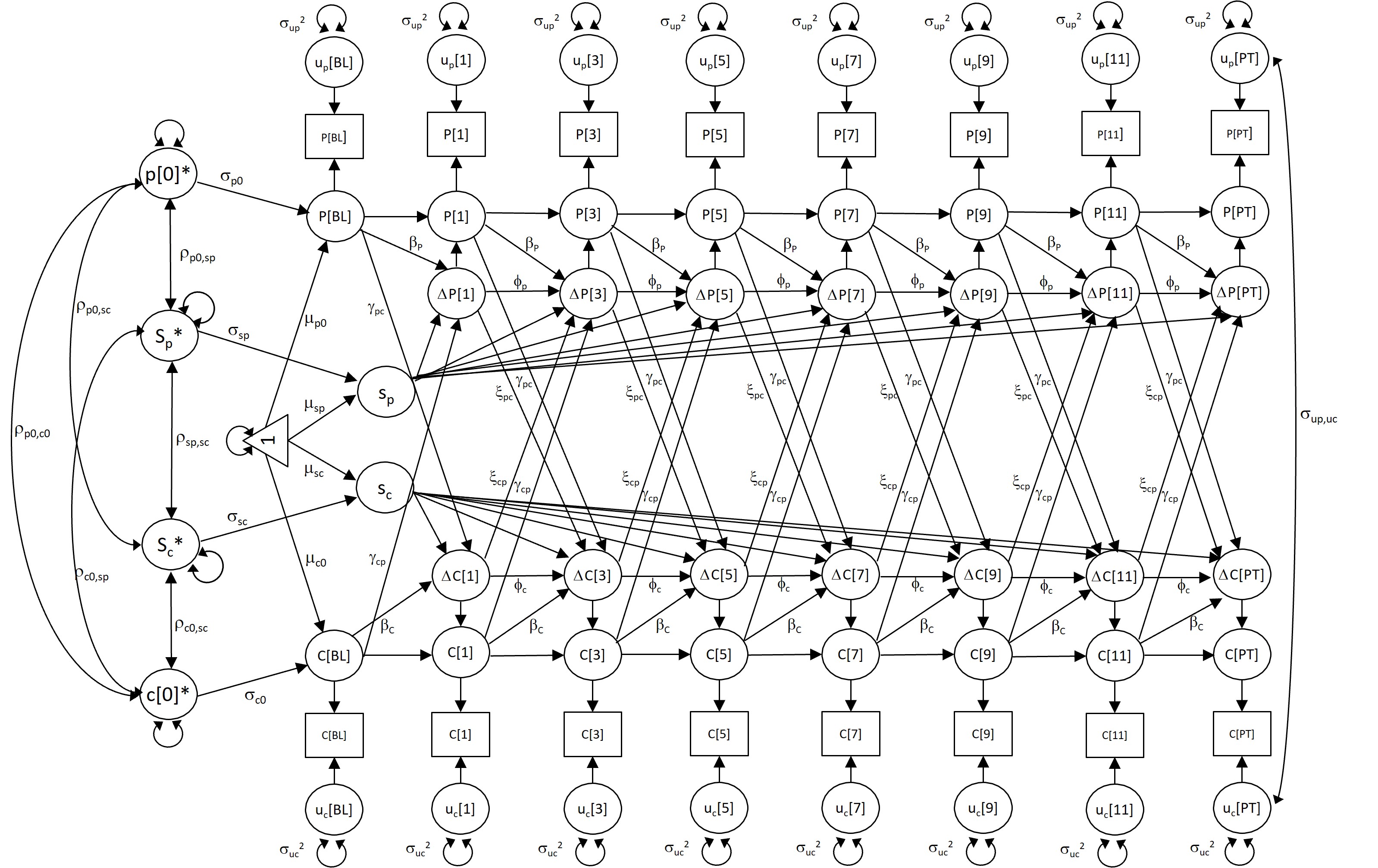
The B-DLCS model is a specialized form of longitudinal structural equation modeling that treats change itself as a variable — not just an outcome. It asks: does the level of one construct influence how much the other changes? And does changing on one construct cause the other to change too?
The full B-DLCS model for 8 timepoints. TRACK CHANGES generates, estimates, and interprets this entire system automatically — you provide the data and specify your constructs.
The model captures four distinct mechanisms across two dimensions — effects on the construct itself, and effects on the other construct:
Does being high on X slow or accelerate subsequent change in X itself? If high PTSD severity predicts less subsequent reduction in PTSD, the construct is self-amplifying. If high PTSD predicts greater subsequent reduction, it is self-correcting.
Does being high on X slow or accelerate change in Y? If PTSD severity predicts less subsequent reduction in self-blame, PTSD is a barrier. If high PTSD predicts greater subsequent reduction in self-blame, PTSD acts as a catalyst.
Does changing on X predict further changing on X? If reduction in PTSD predicts subsequent further reduction, the construct has momentum. If change fades or reverses, the system is damped.
Does moving on X move Y in the same direction or the opposite direction? If reduction in PTSD predicts subsequent reduction in self-blame, PTSD is a lever — change on one construct transfers in kind to the other. If reduction in PTSD instead predicts subsequent increase in self-blame, PTSD is a counterweight — change on one construct inverts to the other.
A complete interpretation specifies both. The first level — the focus of this section — describes the shape of the coupled system: which cross-construct paths are active and how they combine into a topology. The second level — introduced in the next section — describes the clinical mechanism of each active path: what the coupling actually means given the sign of the parameter and the valence of each construct. The first level alone is a common source of interpretive error in published B-DLCS work; the same architecture can correspond to inverse clinical situations in which the intervention logic is opposite.
Starting with Level 1: at the architectural level, BRIDGES identifies which cross-construct paths are retained as statistically significant in the best-fitting model and classifies the system’s topology. These eight architectures exhaust every meaningful combination of active and inactive paths. The architecture label tells the researcher which paths require clinical interpretation — and which do not.
Each architecture above is correct as a summary of the system’s topology. But a significant γ path can represent at least four clinically distinct mechanisms depending on the parameter’s sign and the valences of the two constructs. A significant ξ path can represent four more. The architectural label alone does not specify the clinical meaning. That specification happens at Level 2.
The subtype level specifies what each significant γ or ξ parameter clinically means. Three binary dimensions — the sign of the parameter, the valence of the predictor construct, and the valence of the outcome construct — combine to produce 23 × 2 = 16 exhaustive cells. Every significant coupling path in any bivariate dual LCS analysis falls into exactly one of them.
Seven of the sixteen cells are counterintuitive — the naive reading of the parameter sign produces a clinically incorrect inference, and acting on the naive reading could actively harm the outcome construct. Two cells are direction-dependent — the same parameter produces opposite clinical presentations depending on which way the predictor is currently trending. BRIDGES flags both in every report it generates.
Architecture without subtype is incomplete. Subtype without architecture is fragmentary. BRIDGES returns both — automatically, for every model it fits.
Representative architecture-and-subtype combinations by research domain. The same architecture often corresponds to different subtypes in different contexts — and the subtype determines the intervention logic. Use the tabs to see five integrated examples per domain.
How the platform works — and what it eliminates.
Specify your constructs and valence. BRIDGES handles everything else — and exports the full model code so you can verify every decision.
B-DLCS models answer questions no other longitudinal method can — but six specific barriers have prevented widespread adoption. BRIDGES eliminates each one while preserving analytical rigor and researcher judgment.
TRACK CHANGES was independently validated against expert hand-coded Mplus syntax. Identical parameter estimates, fit statistics, nested model tests, and model selection outcomes across both the univariate and bivariate testing ladders.
TRACK CHANGES runs in any modern browser. The back-end relies exclusively on open-source R packages. Full lavaan and Mplus syntax exported for every model — complete transparency, no black-boxing.
BRIDGES returns the architecture, the subtype of every active path, the current clinical face of every direction-dependent subtype, and the flip conditions that would reverse them — free, in your browser, in under a minute.

CHORDS models change across an entire system of constructs simultaneously — estimating who drives whom, how the network is organized, and where to intervene. The question shifts from does A affect B to what is the architecture of this system.
CHORDS generates a complete characterization of your construct network — which variables drive the system, which absorb influence, how the topology is organized, and where intervention leverage is highest. Two researchers running the same model on different construct sets get completely different system architectures, because the architecture is a property of their data, not an assumption imposed by the method.
Eight capability categories below. Screenshots coming at launch.
CHORDS doesn’t just estimate parameters — it tells you what role each construct plays in the dynamic system your data describes. That’s a fundamentally different output from running BRIDGES on every pair.
CHORDS implements three cumulative layers of longitudinal modeling theory, each one extending the last. Understanding the lineage explains why the model can estimate things no combination of bivariate analyses ever could.
Established the foundational architecture: treating change itself as a latent variable with its own predictors and consequences. The original bivariate framework capturing level-to-change coupling (δ) between two constructs.
Added the change-to-change cross-construct parameter (φ) — testing whether moving on one construct drives moving on another. This is the lever mechanism: therapeutic momentum that transfers across constructs. Implemented in BRIDGES.
Generalized the Grimm-extended model to three or more constructs estimated simultaneously — not pairwise. Introduced the coordination taxonomy: phase, asymmetry, and system architecture as properties of the full coupling matrix. This is the theoretical core of CHORDS.
The critical distinction from bivariate analyses run separately: every parameter in the CHORDS model is mutually adjusted. The δ from PTSD to self-blame means something different when IU is in the model than when it is not — it represents PTSD’s unique contribution to self-blame’s change trajectory after accounting for everything else in the system simultaneously.
CHORDS runs a structured model selection ladder — MV1 through MV6 — that mirrors the BRIDGES approach: univariate pre-selection per construct, then a branching multivariate hierarchy testing whether cross-construct coupling is warranted, whether asymmetric estimation is needed, and pruning non-significant paths from the winner.
Read the foundational papers →Find your field. See what role each variable plays in your system.
Initiates change in the system. Drivers exert strong outgoing influence on other constructs while being relatively insulated from incoming influence. Moving a driver produces the broadest downstream effects.
Absorbs influence from the system without propagating it forward. Sinks are outcome variables — they respond to what other constructs do but don't generate movement elsewhere. They're where the system's effects land.
Transmits influence through the system. Relays receive meaningful incoming influence and pass comparable influence forward — neither initiating nor absorbing dynamics but carrying them through. Intervening on a relay doesn't start things, but blocking a relay can break the chain.
Drives the system AND compounds its own dynamics over time. Amplifiers have both strong outgoing influence on other constructs AND positive self-amplifying within-construct dynamics (positive β or γ). They initiate change and intensify it simultaneously.
| Role | |||
|---|---|---|---|
| Driver | Sink | Relay | Amplifier |
Running BRIDGES on every pair is not the same as running CHORDS. These three concepts only exist when you have at least three constructs modeled simultaneously.
With two variables you can say A affects B more than B affects A. You cannot say anything about what function A plays in a system, because there is no system — there’s just a pair. With three or more variables simultaneously estimated, CHORDS computes outgoing and incoming influence across the full coupling matrix and classifies each construct’s role. Driver, Sink, Relay, Amplifier — these are properties of a node in a network, not properties of a directed relationship. They require a network to exist.
BRIDGES tells you whether a pair is asymmetric, bidirectional, or independent. CHORDS tells you how the whole system is organized — whether influence concentrates in a hub-and-spoke pattern around one dominant driver, flows sequentially through a chain, circulates reciprocally with no clear driver, or is largely fragmented. These are topological properties of the full coupling matrix. They emerge from the pattern of all relationships simultaneously, not from any individual pair.
With two variables you can describe whether they move together or in opposition. With three or more, CHORDS characterizes how the whole system coordinates — whether variables predominantly move in-phase (concordant system-wide movement), anti-phase (push-pull dynamics), or in patterns that vary by pair. Valence-adjusted clinical interpretation tells you whether each coupling relationship is working for or against recovery. Cascade tendency — whether influence propagates sequentially through the system like dominoes — is a system-wide signal with no bivariate analogue. It tells you whether a treatment gain in one variable is likely to reverberate, or whether it stops at the next node.
The interpretive problem that the two-level framework was built to solve in bivariate BRIDGES output does not diminish as the system grows. It intensifies. A five-construct coupling network can contain up to 20 significant cross-construct paths, and each one requires the same architecture + subtype specification to be clinically actionable.
CHORDS applies the same two-level framework that BRIDGES uses. Every significant γ or ξ parameter in the coupling matrix is classified into one of the 16 clinical subtype cells. Counterintuitive configurations — where the naive sign-reading would produce clinically incorrect inference — are flagged for mechanistic investigation. Direction-dependent configurations — where the same parameter produces opposite clinical presentations depending on trajectory direction — are flagged with the current face and the flip condition.
A 5-construct network contains up to 20 cross-construct paths. Without subtype specification, even a correct architectural map of the system produces 20 paths whose clinical meaning is underspecified. With subtype specification, every active path is fully interpretable.
In a fully coupled multivariate system, a single counterintuitive path can invert the intervention implications of a whole arm of the network. CHORDS flags each one and marks it for mechanistic investigation before intervention.
In a network with multiple Coupled Momentum subtypes, any trajectory reversal can trigger multi-path flips simultaneously. CHORDS identifies which paths are on the cascade face and which are one trajectory reversal away from the spiral face.
The two-level architecture + subtype framework, the 16-cell subtype taxonomy, and a complete worked example are on the BRIDGES features page.
How the platform works — and what it does that no bivariate analysis can.
Specify your constructs, their valences, and your timepoints. CHORDS runs univariate pre-selection for each construct independently, then fits the full multivariate model ladder, classifies system roles, characterizes architecture and coordination, and delivers a complete interactive report — no code required.
Every parameter in the CHORDS model is mutually adjusted for every other construct. The δ from PTSD to self-blame means something different when IU is in the model — it represents PTSD’s unique contribution after accounting for everything else simultaneously.
CHORDS implements the same validated BRIDGES architecture — the same automated syntax generation, FIML estimation, and equality-constrained timepoint structure — extended to the multivariate case. The univariate pre-selection stage uses the same model selection ladder that BRIDGES has validated to 100% accuracy against hand-coded Mplus syntax.
When CHORDS launches, it will run in any modern browser on the same platform as BRIDGES — same data format, same report language, same standard of rigor. Free, fully documented, no installation.
Stop running bivariate analyses on a multivariate problem. CHORDS estimates the system your data describes — all at once, no code, publication-ready output.
Standard longitudinal models ask how much people changed. MOMENTS asks when their dynamics shifted, what preceded the shift, and whether the system gave advance warning before it happened.
MOMENTS is built for intensive longitudinal data — ecological momentary assessment, daily diaries, experience sampling. It treats the relationships between variables as things that can change, not fixed constants. The output is not a parameter table. It’s a timeline: when did the system destabilize, did autocorrelation rise before the transition, and what kind of responder was this person over the course of treatment.
Eight capability categories below. Screenshots coming at launch.
MOMENTS tells you not just where the person ended up, but when their dynamics began to shift and whether the system announced it before anyone noticed.
MOMENTS combines three complementary approaches that are each valuable alone but transformative together. Understanding what each one does explains why the integration produces something no single method can.
Standard AR(1) models assume that both the set point (μ) and autoregressive strength (β) are constant throughout the study. The autoregressive strength is the key parameter: it tells you how much yesterday’s score predicts today’s, and it’s interpreted as emotional inertia — how “sticky” the affect state is. High β means slow recovery; low β means fast recovery. A standard model treats this as fixed. TVP–AR(1) lets both parameters evolve across time, generating a trajectory of β_t and μ_t rather than a single estimate.
The standard Reliable Change Index compares two endpoints — a pre-score and a post-score. It was designed for pre-post therapy designs, not for intensive longitudinal data where change unfolds across dozens of assessment points at variable speeds. DARCI extends RCI by scaling the statistical threshold proportionally to the duration of the transition. A change that takes one week needs to clear a lower bar than a change that takes four weeks, because slower transitions show up across more observations and require proportionally larger overall magnitude to qualify as reliable.
Thresholds shown for a measure with SEM = 4.74 (representative BDI-II). DARCI scans every possible 1–4 week window in the data and flags the earliest window where the change clears the duration-adjusted 95% confidence threshold and the post-transition mean holds stable for at least two weeks. The result is a principled, data-driven answer to “when did the transition happen?” rather than an eyeballed inflection point.
Critical slowing down is a dynamical systems phenomenon: as a system approaches a tipping point, it takes longer to recover from small perturbations. In affect data, this shows up as rising autocorrelation — the time series becomes more “sticky,” with each observation predicting the next more strongly than before. MOMENTS computes rolling autocorrelation across a moving window of observations, tests whether it shows a significant upward trend using the Mann-Kendall statistic, and evaluates this signal separately for 3–4 affect variables. A cumulative score summarizes how many variables are showing the signal simultaneously.
MOMENTS reports these benchmarks directly in every output. Early warning signals are probabilistic indicators of destabilization, not deterministic predictions of crisis. The platform never claims otherwise.
Neither method alone gives you the full picture. DARCI identifies when the transition happened but doesn’t tell you what the dynamics looked like before it. Moving-window EWS detects rising autocorrelation but needs a principled transition definition to test whether the signal actually preceded something. TVP-AR models how the dynamics evolved but doesn’t classify the transition type or test its reliability. MOMENTS runs all three in sequence — DARCI defines the transition, TVP-AR models the evolution, moving-window EWS tests whether the system announced the shift before it happened.
Read the foundational papers →Grouping patients by whether their symptoms improved misses the most important clinical question: how did their dynamics change? The Fragile Responder — someone whose symptoms improved but whose autocorrelation stayed elevated — looks like a success story on a symptom slope. MOMENTS knows they’re at elevated relapse risk.
Classification is based on parameter evolution patterns, not symptom levels. The same endpoint can belong to any trajectory type.
Autocorrelation (β_t) drops sharply within the first 1–2 weeks and remains low. The system rapidly reorganizes into a low-inertia, high-resilience state and stays there. These are the cleanest treatment responders.
Autocorrelation declines incrementally across the full treatment period with no discrete transition point. The person is improving — but the improvement is a continuous reorganization rather than a phase shift. DARCI classifies this as a 3–4 week gradual improvement.
The person’s dynamics remain flat for an extended period, then reorganize rapidly and hold in the new state. A clear discrete transition — detectable as both a DARCI sudden gain and an abrupt shift in the TVP-AR parameter trajectory. Often preceded by rising autocorrelation.
Symptom levels improve and DARCI confirms a reliable transition — but autocorrelation (β_t) remains elevated throughout. The system reached a lower symptom set point but retained high inertia. These patients look like treatment successes on symptom measures. They are at elevated relapse risk.
Neither symptom levels nor autocorrelation change meaningfully over the treatment period. DARCI detects no reliable transition. β_t trajectory is flat. This is not the same as gradual improvement — the dynamics are genuinely unchanged. Treatment mechanism may not have engaged.
Multiple DARCI-detected transitions across the study period, alternating between higher and lower symptom states without settling. β_t fluctuates accordingly. These patients are not stalled — their system is genuinely reorganizing repeatedly. They are the highest-complexity responders and the hardest to categorize by symptom slope alone.
Phase 1 MOMENTS runs separate TVP-AR(1) models on each affect variable and shows you the results side by side. That’s useful — but it isn’t a system. In Phase 2, MOMENTS extends to TVP-VAR: every variable’s past predicts every other variable’s future, and all of those coupling strengths are allowed to evolve across time. That’s the difference between four separate timelines and one dynamic network.
One model per variable. Anxiety gets its own β_t trajectory. Rumination gets its own. Depression gets its own. They run in parallel — separate Kalman filters, separate parameter trajectories, separate early warning signal tests. The “system” is a collection of individual pictures laid next to each other.
One model for the whole system. Yesterday’s anxiety, rumination, avoidance, and depression all simultaneously predict today’s anxiety — and simultaneously predict today’s rumination, avoidance, and depression. Every cross-lagged coupling strength is time-varying. The coupling between anxiety and rumination can strengthen in weeks 4–6 and dissolve in weeks 10–12. That’s a dynamic network, not four separate timelines.
Cross-lagged coupling between variables that evolves over time. Did the anxiety→rumination connection strengthen before the crisis? Did the depression→avoidance edge dissolve after the sudden gain? These are questions about how the network reorganized — not about any single variable’s trajectory.
CHORDS estimates a static coupling architecture from wave-level data — the average δ and φ across the whole study period. TVP-VAR estimates how that architecture changed moment to moment from intensive data. Same constructs. Different timescale. Different question. They’re complementary, not redundant.
With four variables, a standard VAR has 20 parameters. Make all 20 time-varying and you’re estimating 20 evolving trajectories from a single person’s data. That requires longer series (100+ observations minimum), more computational time, and more careful regularization. The Phase 1 univariate approach is validated and interpretable. Phase 2 builds on that foundation.
How the pipeline works — and what it can detect that static models cannot.
Upload your intensive longitudinal data, map your variables, and specify any transition anchors (therapy sessions, life events). MOMENTS runs the full three-method pipeline automatically and returns a complete, interpretable timeline of how the person’s dynamics evolved — no time-series expertise required.
A symptom trajectory shows where the person ended up. MOMENTS shows what was happening beneath the trajectory the whole time — and what the data would have told you if you’d been watching the dynamics instead of the symptoms.
MOMENTS implements methods from two peer-reviewed papers with known, published performance characteristics. Helmich et al. (2023) established the sensitivity and false-positive rates for moving-window early warning signals in clinical depression data. Chen et al. (2024) established outlier detection for time-varying parameter models. The platform uses these benchmarks in its own output rather than making unvalidated claims.
When MOMENTS launches, it will run in any modern browser on the same platform as BRIDGES — same data format, same report language, same standard of rigor. Free, fully documented, no installation, no coding required.
Stop asking whether your participants improved. Start asking when their system reorganized, what the data was telling you before it happened, and what trajectory they were actually on. MOMENTS answers all three.
STREAMS asks a different question than every other module in this platform. Not how much people changed — but what discrete states they occupied, and who moved from one to another. The answer is a map of pathways through your data: where people started, where they ended up, and what the flows between states looked like along the way.
STREAMS does not estimate slopes or coupling parameters. It discovers the qualitatively distinct states present in your data at each timepoint — Severe, Moderate, Recovered — and models the probability that someone in one state at time T will be in a different state at time T+1. The output is not a parameter table. It is a transition map: who moved where, how stable each state was, and what the population-level flows looked like across the full study window.
Eight capability categories below. Screenshots coming at launch.
STREAMS answers the questions that continuous change models cannot — because those models assume everyone is on the same trajectory at different rates. STREAMS starts from the premise that some people aren’t on slower trajectories. They’re on different ones entirely.
Continuous change models — growth curves, latent change scores, TVP-AR — assume that individuals vary in the rate of change along a common functional form. That assumption is often wrong. Some people in a depression treatment trial aren’t slow responders on a linear decline — they’re in a Chronic stream that never moves. Some aren’t fast responders — they’re Sudden Gainers who flipped from Severe to Recovered in a single week. Putting both groups in the same continuous model and estimating an average slope misses both stories.
Estimates parameters that describe the average relationship between constructs — coupling strengths, growth factors, autoregressive dynamics. Individual differences appear as deviations from a common functional form. The unit of analysis is the variable and its behavior across people.
Discovers the discrete types of people who exist in the data and models the flows between them. Individual differences are not deviations from an average — they are membership in fundamentally different categories. The unit of analysis is the person and their pathway through qualitatively distinct states.
At each timepoint, each person is probabilistically assigned to one of k latent streams. A stream is defined by its profile — the expected values of the observed indicators given membership in that stream. A person in the Severe PTSD stream has a characteristic pattern of PCL-5 item responses that differs from someone in the Moderate or Recovered stream. The number of streams is not specified in advance: STREAMS tests k=2 through k=10 and selects the solution that minimizes BIC, flagging any solution where entropy falls below 0.80.
STREAMS is most powerful in combination with the other modules. BRIDGES or CHORDS detect significant slope variance in a continuous change model — evidence that the population isn’t following a single trajectory. STREAMS then characterizes what those multiple trajectories actually look like as discrete streams and maps the flows between them. The continuous and categorical perspectives converge on the same data from different angles: one tells you how much people changed, the other tells you which type of changer each person was.
Read the foundational papers →These are the six prototypical trajectory patterns that emerge from LTA across clinical, behavioral, and organizational research. The same person who looks like a treatment success on a symptom slope might be a Fragile Improver on stream analysis — a person whose improvement was real but whose return to the Severe stream at follow-up was never predicted by the continuous model.
Pathway type is defined by stream membership sequences, not symptom levels. Same BDI at discharge can belong to any type.
Moves consistently through adjacent streams in the improving direction across every transition interval — Severe to Moderate to Low — without reversal. The model's ideal responder. High transition probability across every adjacent pair in the improving direction.
Remains in the same stream for multiple consecutive intervals, then transitions directly to a substantially different stream in a single interval, and holds there. The stream-based equivalent of a DARCI-detected sudden gain — but identified here by transition probability patterns rather than symptom magnitude.
Extremely high stability probability in the same stream across every transition interval — typically the most severe or most impaired stream. Not a slow responder on a continuous trajectory. A person for whom the treatment mechanism never engaged at the level required to produce stream change.
Successfully transitions to a lower-severity or more functional stream, maintains that position for one or more intervals, then returns to a higher-severity stream. The relapse pattern. Distinguished from an Oscillator by the presence of a sustained improvement phase before the return.
Multiple transitions across the study period without settling into a stable stream. Unlike the Fragile Improver, there is no sustained improvement phase — the person cycles between streams at nearly every interval. High off-diagonal transition probabilities in multiple directions simultaneously.
Remains in the initial stream for the first half or more of the study period, then successfully transitions to a better stream in the later intervals. Not a non-responder — a delayed responder whose treatment mechanism took longer to engage. Missed by analyses that only examine early change.
Select a domain to see field-specific examples of each stream pathway type.
| Pathway Type |
|---|
These three questions require discrete states, transition probabilities, and individual pathway classification. No amount of slope estimation answers them.
A PHQ-9 of 12 and a PHQ-9 of 13 are not meaningfully different on a continuous scale. But one person might be solidly in the Moderate stream and another might be in the Severe stream with a particularly good day. Continuous models treat these as adjacent points on a number line. STREAMS treats them as potentially different categories with different profiles, different transition probabilities, and different prognoses. The clinical question “is this patient in remission?” is a categorical question. It deserves a categorical model.
The probability of moving from Low to Severe (relapse) is not the inverse of the probability of moving from Severe to Low (recovery). Continuous models impose a symmetry that the data often violates. The transition matrix is asymmetric by nature — and that asymmetry is clinically meaningful. If recovery has a 0.40 probability and relapse has a 0.25 probability, the system is biased toward improvement. If those numbers are reversed, extended monitoring is indicated regardless of what the symptom slope suggests.
| To: Severe | To: Moderate | To: Low | |
| From: Severe | 0.65 | 0.30 | 0.05 |
| From: Moderate | 0.10 | 0.70 | 0.20 |
| From: Low | 0.05 | 0.15 | 0.80 |
Diagonal = stability. Recovery (Severe→Low) = 0.05. Relapse (Low→Severe) = 0.05. Recovery is not more likely than relapse here — and neither the slope nor the endpoint tells you that.
Running separate LTA models on depression and anxiety and comparing results misses the most important question: do depression stream transitions predict anxiety stream transitions, or do the two constructs move independently? Parallel process LTA estimates joint stream profiles — High Depression × High Anxiety, High Depression × Low Anxiety, and so on — and models cross-construct transition effects directly. If being in the Severe Anxiety stream at T significantly reduces the probability of transitioning out of the Severe Depression stream at T+1, that’s a treatment planning finding that no bivariate comparison can produce.
How the pipeline works — and what makes the output different from any existing LTA tool.
Specify your construct, its indicators, and your timepoints. STREAMS runs the full LTA pipeline automatically — data preparation, model selection across all candidate k values, parameter extraction, and HTML report generation with interactive visualizations. No code required, no manual model comparison, no separate extraction scripts.
Existing LTA tools require commercial software licenses, manual syntax files, separate extraction scripts, and custom code for every visualization. STREAMS is one R file. Run it, get everything.
Latent transition analysis is a well-established method with 30+ years of methodological development. STREAMS implements it via depmixS4, a peer-reviewed R package for hidden Markov models and mixture models, with best-practice defaults: 50 random starts, BIC selection, entropy reporting, BCH correction for distal outcomes, and automatic row-normalization of transition matrices.
When STREAMS launches, it will run in any modern browser on the same platform as the rest of TRACK CHANGES — same data format, same report language, same standard of rigor. Free, fully documented, no installation required.
Some are Chronic Non-Movers. Some are Sudden Gainers. Some are Fragile Improvers who look like successes until the follow-up. STREAMS finds all of them — automatically, for free, in one R file.
CHORDS is currently in development. When it launches, it will be free, fully documented, and integrated into the TRACK CHANGES platform.
MOMENTS is currently in development. When it launches, it will be free, fully documented, and integrated into the TRACK CHANGES platform.
STREAMS is currently in development. When it launches, it will be free, fully documented, and integrated into the TRACK CHANGES platform.
Foundational methods papers and applied examples using multivariate latent change score models — estimating the full coupling architecture of psychological networks across time. Spanning cognitive aging, personality, clinical psychology, education, and organizational research.
Papers that define the simultaneous multivariate LCS framework, establish its mathematical properties, and demonstrate its advantages for modeling the full coupling architecture of psychological networks across time.
Butner, J. E., Berg, C. A., Baucom, B. R., & Wiebe, D. J. (2014). Modeling coordination in multiple simultaneous latent change scores. Multivariate Behavioral Research, 49(6), 554–570. doi:10.1080/00273171.2014.934321
Grimm, K. J., An, Y., McArdle, J. J., Zonderman, A. B., & Resnick, S. M. (2012). Recent changes leading to subsequent changes: Extensions of multivariate latent difference score models. Structural Equation Modeling, 19(2), 268–292. doi:10.1080/10705511.2012.659627
McArdle, J. J. (2009). Latent variable modeling of differences and changes with longitudinal data. Annual Review of Psychology, 60, 577–605. doi:10.1146/annurev.psych.60.110707.163612
Butner, J. E., Gagnon, K. T., Geuss, M. N., Lessard, D. A., & Story, T. N. (2015). Utilizing topology to generate and test theories of change. Psychological Methods, 20(1), 1–25. doi:10.1037/a0037802
Hamaker, E. L., Kuiper, R. M., & Grasman, R. P. P. P. (2015). A critique of the cross-lagged panel model. Psychological Methods, 20(1), 102–116. doi:10.1037/a0038889
Kievit, R. A., Brandmaier, A. M., Ziegler, G., van Harmelen, A. L., de Mooij, S. M. M., Moutoussis, M., Bullmore, E., Goodyer, I. M., & Dolan, R. J. (2018). Developmental cognitive neuroscience using latent change score models: A tutorial and applications. Developmental Cognitive Neuroscience, 33, 99–117. doi:10.1016/j.dcn.2017.11.007
Ferrer, E., & Nesselroade, J. R. (2003). Modeling affective processes in dyadic relations via dynamic factor analysis. Emotion, 3(4), 344–360. doi:10.1037/1528-3542.3.4.344
Borsboom, D., & Cramer, A. O. J. (2013). Network analysis: An integrative approach to the structure of psychopathology. Annual Review of Clinical Psychology, 9, 91–121. doi:10.1146/annurev-clinpsy-050212-185608
Published studies using multivariate latent change score models to answer questions about how systems of constructs drive each other over time — across cognitive aging, clinical, developmental, and organizational domains.
Bryan, C. J., Butner, J. E., Tabares, J. V., Brown, L. A., Young-McCaughan, S., Hale, W. J., Litz, B. T., Yarvis, J. S., Fina, B. A., Foa, E. B., Resick, P. A., & Peterson, A. L. for the STRONG STAR Consortium (2024). A dynamical systems analysis of change in PTSD symptoms, depression symptoms, and suicidal ideation among military personnel during treatment for PTSD. Journal of Affective Disorders, 350, 125–132. doi:10.1016/j.jad.2023.12.063
Kievit, R. A., et al. (2016). Distinct aspects of frontal lobe structure mediate age-related differences in fluid intelligence and multitasking. Nature Communications, 7, 13240. doi:10.1038/ncomms13240
Orth, U., Robins, R. W., & Roberts, B. W. (2008). Low self-esteem prospectively predicts depression in adolescence and young adulthood. Journal of Personality and Social Psychology, 95(3), 695–708. doi:10.1037/0022-3514.95.3.695
Orth, U., Erol, R. Y., & Luciano, E. C. (2018). Development of self-esteem from age 4 to 94 years: A meta-analysis of longitudinal studies. Psychological Bulletin, 144(10), 1045–1080. doi:10.1037/bul0000161
Ghisletta, P., & Lindenberger, U. (2003). Age-based structural dynamics between perceptual speed and knowledge in the Berlin Aging Study: Direct evidence for ability dedifferentiation in old age. Psychology and Aging, 18(4), 696–713. doi:10.1037/0882-7974.18.4.696
Teachman, B. A., Joormann, J., Steinman, S. A., & Gotlib, I. H. (2012). Automaticity in anxiety disorders and major depressive disorder. Clinical Psychology Review, 32(6), 575–603. doi:10.1016/j.cpr.2012.06.004
Kline, A. C., Cooper, A. A., Rytwinksi, N. K., & Feeny, N. C. (2018). Long-term efficacy of psychotherapy for posttraumatic stress disorder: A meta-analysis of randomized controlled trials. Clinical Psychology Review, 59, 30–40. doi:10.1016/j.cpr.2017.10.009
Wille, B., Hofmans, J., Feys, M., & De Fruyt, F. (2016). How affective commitment to the organization changes over time: A longitudinal analysis of the reciprocal relationships between affective organizational commitment and income. Journal of Organizational Behavior, 37, 515–536. doi:10.1002/job.2045
Grimm, K. J. (2008). Longitudinal associations between reading and mathematics achievement. Developmental Neuropsychology, 33(3), 410–426. doi:10.1080/87565640801982486
McArdle, J. J., Ferrer-Caja, E., Hamagami, F., & Woodcock, R. W. (2002). Comparative longitudinal structural analyses of the growth and decline of multiple intellectual abilities over the life span. Developmental Psychology, 38(1), 115–142. doi:10.1037/0012-1649.38.1.115
Murayama, K., Pekrun, R., Lichtenfeld, S., & vom Hofe, R. (2013). Predicting long-term growth in students' mathematics achievement: The unique contributions of motivation and cognitive strategies. Child Development, 84(4), 1475–1490. doi:10.1111/cdev.12036
Turiano, N. A., Mroczek, D. K., Moynihan, J., & Chapman, B. P. (2013). Big 5 personality traits and interleukin-6: Evidence for 'healthy neuroticism' in a US population sample. Brain, Behavior, and Immunity, 28, 83–89. doi:10.1016/j.bbi.2012.10.020
We feature published and in-press papers that applied these methods in their analyses. If your paper belongs here, let us know.
Submit Your Paper →Foundational methods papers and applied examples using intensive longitudinal and ecological momentary assessment methods — from the theoretical basis of critical transitions to real-time symptom monitoring, early warning signals, and within-person dynamics.
The papers that establish the theoretical and methodological foundations for detecting temporal shifts, critical transitions, and early warning signals in intensive longitudinal and EMA data — from dynamical systems theory to clinical application.
Helmich, M. A., Smit, A. C., Bringmann, L. F., Schreuder, M. J., Oldehinkel, A. J., Wichers, M., & Snippe, E. (2023). Detecting impending symptom transitions using early warning signals in individuals receiving treatment for depression. Clinical Psychological Science, 11(6), 994–1010. doi:10.1177/21677026221137006
Chen, S., Hamaker, E. L., Schuurman, N. K., Sjak-Shie, E., & Helm, J. L. (2024). Outlier detection methods for time-varying parameter models. British Journal of Mathematical and Statistical Psychology, 77(2), 380–405. doi:10.1111/bmsp.12330
Scheffer, M., Bascompte, J., Brock, W. A., Brovkin, V., Carpenter, S. R., Dakos, V., Held, H., van Nes, E. H., Rietkerk, M., & Sugihara, G. (2009). Early-warning signals for critical transitions. Nature, 461, 53–59. doi:10.1038/nature08227
Bolger, N., & Laurenceau, J. P. (2013). Intensive Longitudinal Methods: An Introduction to Experience Sampling and Diary Designs. Guilford Press.
Myin-Germeys, I., Krabbendam, L., Delespaul, P., & van Os, J. (2003). Do life events have their effect on psychosis by influencing the emotional reactivity to daily life stress? Psychological Medicine, 33(2), 327–333. doi:10.1017/S0033291702006785
van de Leemput, I. A., Wichers, M., Cramer, A. O. J., Borsboom, D., Tuerlinckx, F., Kuppens, P., van Nes, E. H., Viechtbauer, W., Giltay, E. J., Aggen, S. H., Derom, C., Jacobs, N., Kendler, K. S., van der Maas, H. L. J., Neale, M. C., Peeters, F., Thiery, E., Zachar, P., & Scheffer, M. (2014). Critical slowing down as early warning for the onset and termination of depression. Proceedings of the National Academy of Sciences, 111(1), 87–92. doi:10.1073/pnas.1312114110
Hamaker, E. L. (2012). Why researchers should think 'within-person': A paradigmatic rationale. In M. R. Mehl & T. S. Conner (Eds.), Handbook of Research Methods for Studying Daily Life (pp. 43–61). Guilford Press.
Wichers, M., Groot, P. C., & Psychosystems, E. S. M. G. (2016). Critical slowing down as a personalized early warning signal for depression. Psychotherapy and Psychosomatics, 85(2), 114–116. doi:10.1159/000441458
Olthof, M., Hasselman, F., Strunk, G., van Rooij, M., Aas, B., Helmich, M. A., Schiepek, G., & Lichtwarck-Aschoff, A. (2020). Critical fluctuations as an early-warning signal for sudden gains and losses in patients receiving psychotherapy for mood disorders. Clinical Psychological Science, 8(1), 25–35. doi:10.1177/2167702619865969
Borsboom, D., & Cramer, A. O. J. (2013). Network analysis: An integrative approach to the structure of psychopathology. Annual Review of Clinical Psychology, 9, 91–121. doi:10.1146/annurev-clinpsy-050212-185608
Published studies using EMA, experience sampling, and intensive longitudinal designs to map within-person dynamics, identify tipping points, and detect the moment-by-moment signals buried in high-density data — across clinical psychology, psychiatry, health, and cognitive science.
Bringmann, L. F., Vissers, N., Wichers, M., Geschwind, N., Kuppens, P., Peeters, F., Borsboom, D., & Tuerlinckx, F. (2013). A network approach to psychopathology: New insights into clinical longitudinal data. PLOS ONE, 8(4), e60188. doi:10.1371/journal.pone.0060188
Fisher, A. J., Reeves, J. W., Lawyer, G., Medaglia, J. D., & Rubel, J. A. (2017). Exploring the idiographic dynamics of mood and anxiety via network analysis. Journal of Abnormal Psychology, 126(8), 1044–1056. doi:10.1037/abn0000311
Wichers, M., Peeters, F., Geschwind, N., Jacobs, N., Simons, C. J. P., Derom, C., Thiery, E., Delespaul, P., & van Os, J. (2010). Unveiling patterns of affective responses in daily life may improve outcome prediction in depression: A momentary assessment study. Acta Psychiatrica Scandinavica, 123(6), 489–497. doi:10.1111/j.1600-0447.2010.01652.x
Snippe, E., Simons, C. J. P., Hartmann, J. A., Menne-Lothmann, C., Kramer, I., Booij, S. H., Viechtbauer, W., Peeters, F., van Os, J., & Wichers, M. (2017). The impact of treatments for depression on the dynamic network structure of mental states. PLOS ONE, 12(2), e0172494. doi:10.1371/journal.pone.0172494
Myin-Germeys, I., van Os, J., Schwartz, J. E., Stone, A. A., & Delespaul, P. A. (2001). Emotional reactivity to daily life stress in psychosis. Archives of General Psychiatry, 58(12), 1137–1144. doi:10.1001/archpsyc.58.12.1137
Hultsch, D. F., MacDonald, S. W. S., & Dixon, R. A. (2002). Variability in reaction time performance of younger and older adults. Journals of Gerontology: Psychological Sciences, 57B(2), P101–P115. doi:10.1093/geronb/57.2.P101
Schiepek, G., Aichhorn, W., Gruber, M., Strunk, G., Bachler, E., & Aas, B. (2016). Real-time monitoring of psychotherapeutic processes: Concept and compliance. Frontiers in Psychology, 7, 604. doi:10.3389/fpsyg.2016.00604
Kuppens, P., Allen, N. B., & Sheeber, L. B. (2010). Emotional inertia and psychological maladjustment. Psychological Science, 21(7), 984–991. doi:10.1177/0956797610372634
Haken, H., Tschacher, W., & Schiepek, G. (2010). A mathematical model of therapeutic processes. In G. Schiepek (Ed.), Neurobiologie der Psychotherapie. Schattauer.
Koenders, M. A., Giltay, E. J., Spinhoven, P., Spijker, A. T., Manber, R., & Elzinga, B. M. (2015). Longitudinal associations between sleep and mood in bipolar disorder patients and controls. Journal of Affective Disorders, 180, 172–178. doi:10.1016/j.jad.2015.04.005
Myin-Germeys, I., Klippel, A., Steinhart, H., & Reininghaus, U. (2016). Ecological momentary interventions in psychiatry. Current Opinion in Psychiatry, 29(4), 258–263. doi:10.1097/YCO.0000000000000255
We feature published and in-press papers that applied these methods in their analyses. If your paper belongs here, let us know.
Submit Your Paper →Foundational methods papers and applied examples using Latent Transition Analysis — estimating discrete symptom states, modeling movement between them across time, and identifying what predicts who transitions, who stays, and which states are absorbing.
The papers that establish the latent transition analysis framework — from the original formulation to modern extensions with covariates, mixture modeling, and the statistical criteria for identifying the correct number of latent states.
Collins, L. M., & Lanza, S. T. (2010). Latent Class and Latent Transition Analysis: With Applications in the Social, Behavioral, and Health Sciences. Wiley.
Graham, J. W., Collins, L. M., Wugalter, S. E., Chung, N. K., & Hansen, W. B. (1991). Modeling transitions in latent stage-sequential processes: A substance use prevention example. Journal of Consulting and Clinical Psychology, 59(1), 48–57. doi:10.1037/0022-006X.59.1.48
Lanza, S. T., Patrick, M. E., & Maggs, J. L. (2010). Latent transition analysis: Benefits of a latent variable approach to modeling transitions in substance use. Journal of Drug Issues, 40(1), 93–120. doi:10.1177/002204261004000106
Nylund, K. L., Asparouhov, T., & Muthén, B. O. (2007). Deciding on the number of classes in latent class analysis and growth mixture modeling: A Monte Carlo simulation study. Structural Equation Modeling, 14(4), 535–569. doi:10.1080/10705510701575396
Bolck, A., Croon, M., & Hagenaars, J. (2004). Estimating latent structure models with categorical variables: One-step versus three-step estimators. Political Analysis, 12(1), 3–27. doi:10.1093/pan/mph001
Chung, H., Park, Y., & Lanza, S. T. (2005). Latent transition analysis with covariates: Pubertal timing and substance use behaviours in adolescent females. Statistics in Medicine, 24(18), 2895–2910. doi:10.1002/sim.2148
Reboussin, B. A., Reboussin, D. M., Liang, K. Y., & Anthony, J. C. (1998). Latent transition modeling of progression of health-risk behavior. Multivariate Behavioral Research, 33(4), 457–478. doi:10.1207/s15327906mbr3304_2
Vermunt, J. K. (2010). Latent class modeling with covariates: Two improved three-step approaches. Political Analysis, 18(4), 450–469. doi:10.1093/pan/mpq025
Jung, T., & Wickrama, K. A. S. (2008). An introduction to latent class growth analysis and growth mixture modeling. Social and Personality Psychology Compass, 2(1), 302–317. doi:10.1111/j.1751-9004.2007.00054.x
Published studies using latent transition analysis to answer questions about discrete change — recovery trajectories, state stability, transition probabilities, and pathway heterogeneity — across substance use, depression, anxiety, chronic pain, and developmental research.
Lanza, S. T., & Collins, L. M. (2006). A mixture model of discontinuous development in heavy drinking from ages 18 to 30: The role of college enrollment. Journal of Studies on Alcohol, 67(4), 552–561. doi:10.15288/jsa.2006.67.552
Fava, G. A., Ruini, C., Rafanelli, C., Finos, L., Conti, S., & Grandi, S. (2004). Six-year outcome of cognitive behavior therapy for prevention of recurrent depression. American Journal of Psychiatry, 161(10), 1872–1876. doi:10.1176/ajp.161.10.1872
Galatzer-Levy, I. R., & Bryant, R. A. (2013). 636,120 ways to have posttraumatic stress disorder. Perspectives on Psychological Science, 8(6), 651–662. doi:10.1177/1745691613504115
Booth, B. M., Fortney, S. M., Fortney, J. C., Curran, G. M., & Blow, F. C. (2001). Short-term course of drinking in an untreated sample of at-risk drinkers. Journal of Studies on Alcohol, 62(5), 580–588. doi:10.15288/jsa.2001.62.580
Beesdo, K., Knappe, S., & Pine, D. S. (2009). Anxiety and anxiety disorders in children and adolescents: Developmental issues and implications for DSM-V. Psychiatric Clinics of North America, 32(3), 483–524. doi:10.1016/j.psc.2009.06.002
Velicer, W. F., Martin, R. A., & Collins, L. M. (1996). Latent transition analysis for longitudinal data. Addiction, 91(Suppl.), S197–S209. doi:10.1111/j.1360-0443.1996.tb02339.x
Denison, E., østbye, T., Furlanetto, L. M., & Mykletun, A. (2004). Determining the latent class structure of chronic pain patients. European Journal of Pain, 8(5), 471–480. doi:10.1016/j.ejpain.2003.11.008
Eddy, K. T., Dorer, D. J., Franko, D. L., Tahilani, K., Thompson-Brenner, H., & Herzog, D. B. (2008). Diagnostic crossover in anorexia nervosa and bulimia nervosa: Implications for DSM-V. American Journal of Psychiatry, 165(2), 245–250. doi:10.1176/appi.ajp.2007.07060951
Muthén, B., & Muthén, L. K. (2000). Integrating person-centered and variable-centered analyses: Growth mixture modeling with latent trajectory classes. Alcoholism: Clinical and Experimental Research, 24(6), 882–891. doi:10.1111/j.1530-0277.2000.tb02070.x
Judd, L. L., Akiskal, H. S., Schettler, P. J., Endicott, J., Leon, A. C., Solomon, D. A., Coryell, W., Maser, J. D., & Keller, M. B. (2005). Psychosocial disability in the course of bipolar I and II disorders. Archives of General Psychiatry, 62(12), 1322–1330. doi:10.1001/archpsyc.62.12.1322
Lavner, J. A., & Bradbury, T. N. (2010). Patterns of change in marital satisfaction over the newlywed years. Journal of Marriage and Family, 72(5), 1171–1187. doi:10.1111/j.1741-3737.2010.00757.x
We feature published and in-press papers that applied these methods in their analyses. If your paper belongs here, let us know.
Submit Your Paper →